
Understanding Power of Attorney When Supporting Aging Parents
As parents age, adult children often find themselves stepping into caregiving roles. What often starts as helping with errands or doctor’s appointments can quickly evolve into managing medications, paying bills, or making urgent medical decisions. One of the most effective ways to prepare for this transition is by setting up a power of attorney (POA).
What a power of attorney does
A power of attorney is a legal document that allows someone the authority to act on behalf of another person. For adult children, this becomes essential in moments when your loved one can’t manage things independently.
For example, if a parent is unexpectedly hospitalized, doctors may be unable to discuss their condition with you or consider your input on treatment decisions without a healthcare POA. Or consider a loved one who starts experiencing cognitive decline. You may notice bills going unpaid or unusual financial decisions being made, but without a financial POA, you might not be able to access accounts or correct the situation.
A POA removes these barriers by clearly authorizing someone to act when it matters most.
How to start the conversation
For many children, the most difficult part of this transition is bringing it up, especially if parents are hesitant or resistant. Parents often express concerns about losing their independence or feel that their children are trying to take control. It helps to frame the conversation around preparation rather than focusing solely on decline.
When discussing this with your parents, it’s helpful to explain that they can direct how they want to receive treatment. Instead of saying, “What happens if you can’t make decisions anymore,” try something more practical like “I want to make sure we can respect your wishes if anything unexpected happens.”
You can also highlight everyday examples, such as travel, temporary illness, or even a short hospital stay, as situations that can create gaps if someone needs to step in. This conversation can help your parents feel respected and involved in their care decisions, relieving stress and anxiety for the child authorized to make decisions.
Understanding the different types of POAs
A common misconception is that a power of attorney is a single, one-size-fits-all document. However, it’s important to note that not all POA documents are the same. Depending on how the document is drafted, the designated individual may be able to manage financial accounts, insurance matters, legal paperwork, or healthcare decisions.
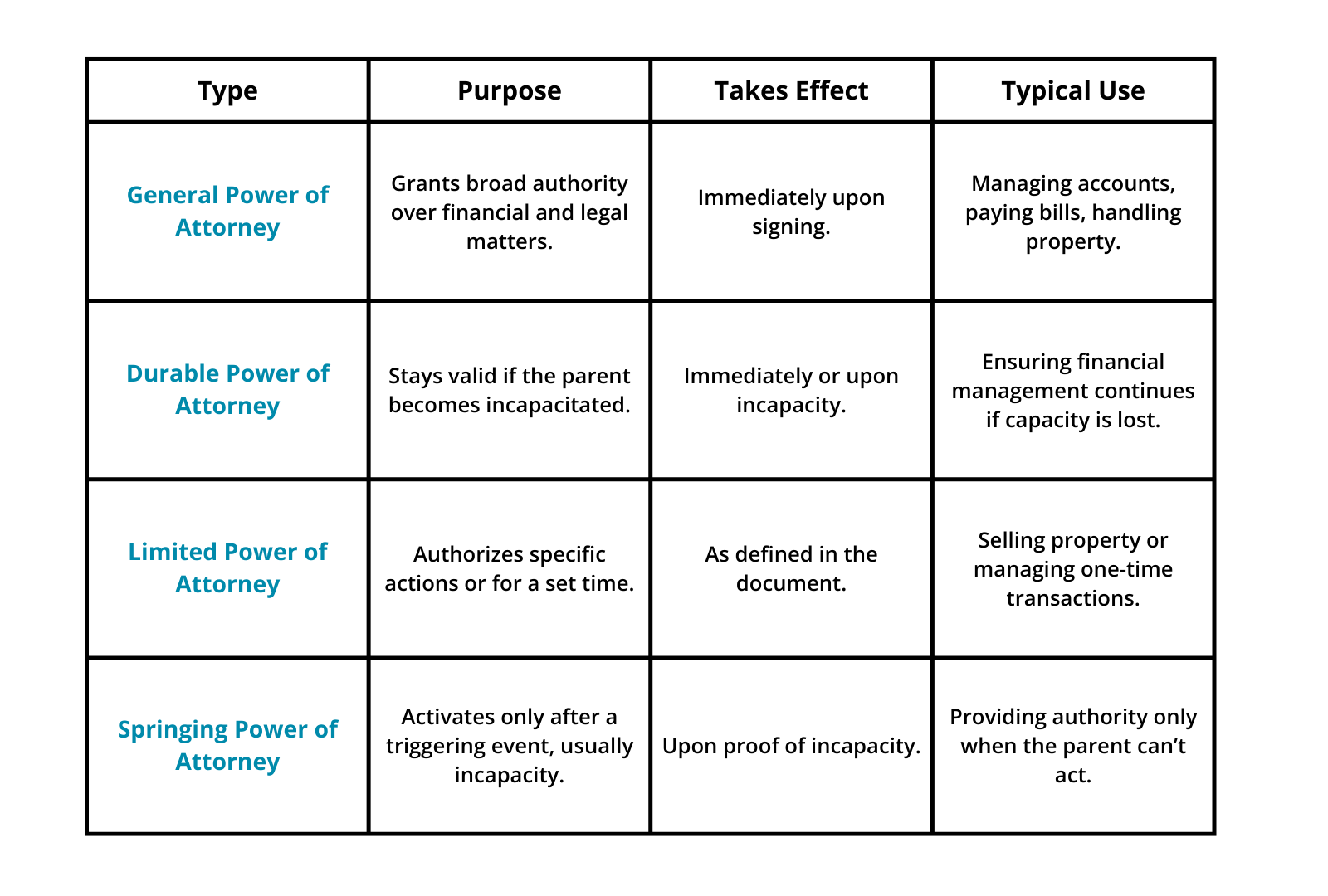
Some families will opt for separating responsibilities. For example, one sibling may handle financial matters because they’re organized, while the other may take on healthcare decisions because they live nearby and can attend appointments. These directives and powers can reflect your family dynamic and parents’ preferences for treatment.
When to establish a power of attorney
Many families wait until something goes wrong before thinking about legal documents. Unfortunately, that’s usually when it’s too late. The best time to create a power of attorney is before a crisis occurs.
To establish a power of attorney, your loved one must still be mentally capable of understanding and signing it. If they have already experienced impaired decision-making, the option to create one may no longer be available.
Consider establishing a POA if your parent:
- is planning for retirement,
- is planning long-term care arrangements,
- has been diagnosed with a medical condition, or
- shows signs of memory loss
Without power of attorney, families may need to petition the court for conservatorship or guardianship over their parents’ financial and medical affairs. This legal process can be time-consuming, expensive, and emotionally distressing for families who are already facing a difficult situation.
But families who plan ahead can act immediately. If your father falls and needs rehabilitation, you can coordinate care and handle insurance without delays. If your mother is recovering from surgery, you could manage finances seamlessly while they focus on healing.
What it means to be named as a power of attorney
Being designated as a power of attorney is a legal responsibility. If you’re acting for a parent, that could look like keeping careful records of how their money is spent, making sure their bills are paid on time, and avoiding any decisions that could benefit you at their expense.
Decisions should always reflect what they would want, not just what seems easiest in the moment. This structure exists to protect the person granting authority, while giving families the ability to act when necessary.
A power of attorney is one of the simplest ways to protect your parents or spouse from unnecessary complications during already stressful moments. Without it, even the most responsible and involved family members can’t help when it matters most.
Since laws vary state by state, always consult an attorney to understand the legal options available to you. This guidance can make you feel more supported and confident in making the best decisions for your family’s needs.
Related Resources

National Elder Law Month: What You Need to Know about the Power of Attorney For Healthcare
The National Academy of Elder Law Attorneys (NAELA) has designated May as “Elder Law Month” to acknowledge a profession that supports the senior community with all their planning needs. During this month, professionals across the country educate the public about legal options for dealing with long-term…

Caring for Elderly Parents
Caring for our elderly parents is one of the most personal and complex challenges we face. For some, it happens suddenly after a health crisis. Others may notice small changes in memory or mood that are easy to overlook at first. Whatever the path, caregiving asks us to balance emotional, practical…

Managing Aging Parents’ Finances with Ease
Start the money conversations early As our parents age, conversations about money can become some of the hardest to have. But discussing your elderly parents’ finances early allows time for thoughtful planning and helps everyone adjust emotionally. It’s important to approach the conversation…

National Estate Planning Awareness Month: What You Need to Know About Estate Planning for The Elderly
October is National Estate Planning Awareness month. Each October across the United States, individuals and families are reminded of the importance of creating and/or maintaining an estate plan. Creating a will or estate plan is essential for everyone, but especially important for seniors.Estate planning…